Nov 20, 2026
How to Choose Kitchen Bar Stool for Restaurant and Apartment Projects
Start with the counter height when picking out a kitchen bar stool for an apartment or restaurant. Then, make sure that the materials, load rating, seat height, and space per seat are all right for how people will use it. About 36-inch countertops go with 24- to 26-inch seats, and 40- to 42-inch bar tops go with 28- to 30-inch seats. Allow 24 to 30 inches of space between each stool's seat and the bottom of the counter. Leave 9 to 12 inches of space between them. Check the frame's strength, the upholstery, the certificates, and the supplier's support next. I'll explain each step below and use our YB-1146 as an example.
Define the Project and Get the Measurements Right
Start With the Project Type and Use Pattern
In every sale, the first thing I ask is, "Who sits here, and for how long?" A few quick meals are eaten at an apartment breakfast bar every day. A restaurant counter gets sat on, spilled on, dragged, and cleaned every night. A store chain that buys private-label goods needs a model that works in a lot of different homes. Write up a short specification sheet before you ask for quotes. Type of project, counter height, quantity, destination, delivery date, style, and any standards your project needs should all be written down. Having a clear sheet cuts down on emails with suppliers. It also stops orders for the wrong height, which costs a lot to fix because stools are heavy to ship back.
Match Seat Height to Counter Height
A bar-height surface is about 40 to 42 inches high, and a seat is about 28 to 30 inches high. Leave about 9 to 12 inches (23 to 30 cm) of space between the seat and the bottom of the counter so that your knees and thighs can fit comfortably.
Allow Enough Space Per Seat
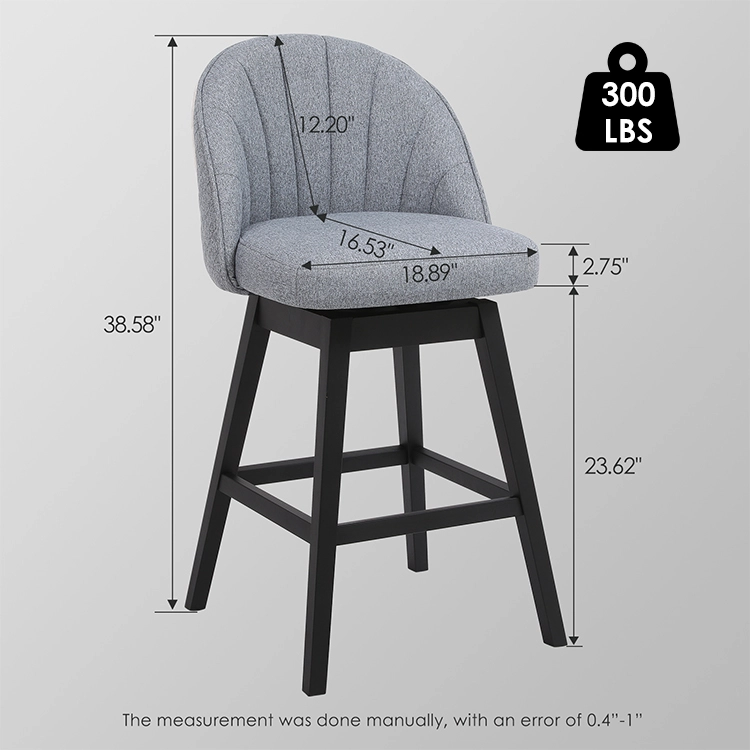
Plan for each stool to be 24 to 30 inches wide. If the seat has arms, a wide upholstered shell, or a mechanism for turning, go with the wider width. YB-1146 is 47 cm (18.5 inches) wide, which is right in that range. Also, leave space behind people who are sitting so that staff and neighbors can get by. Check the local building codes to see how wide an aisle can be before you decide how to set it up in a restaurant. In an apartment, you should measure the island, the path of the fridge, and the dishwasher's opening.
Choose Size, Ergonomics, and Style
Check Seat Dimensions and Back Support
Together, look at the seat's width, depth, height, base footprint, backrest position, and footrest position. Stools without backs fit close together and are good for short stays. For longer meals, which is important in restaurants and home kitchens, stools with backs are better. Armrests make the chair more comfortable, but they can make it hard to fully tuck under. It's 47 x 42 x 97 cm, which is about 18.5 x 16.5 x 38.2 inches, which means it doesn't take up much space and is great for small apartments and restaurant counters. Round edges, a stable footrest, and feet that don't slip are also important because guests will be getting on and off of a tall stool a lot.
Decide Between Swivel and Fixed Designs
Some stools can be swiveled so that guests can face a conversation or the kitchen. They also make it easier to get in and out of small spaces. The trade-off is that the mechanism has a part that moves. It needs strong hardware to work quietly and to protect the floor below. Fixed stools are easier to clean and work well at counters with a lot of foot traffic because they have fewer parts. The YB-1146 has a rotating square bracket that should be tested on a sample to see how it moves, makes noise, and how well it holds things together. Before you give the go-ahead for mass production, I think you should sit on the sample, turn it over while it's fully loaded, and check the joints.
Pick a Style That Fits the Space and the Shelf
It's easier for stores to keep enough stock on hand when the kitchen bar stool in restaurants matches the color scheme of the brand, the counter, and the floor. The YB-1146 has jet-black rubber wood feet, which are a modern and neutral choice. You can change the colors, materials, and bases to make it fit your own brand.
Match Materials and Durability to the Environment
Frames and Feet
It's the frame's job to hold the weight, so find out about the tube thickness, weld quality, and joints. Steel that is powder-coated or doesn't rust works well in humid kitchens and busy restaurants. Wooden panels and solid wood keep you warm, but they need to be sealed in wet places. Felt, rubber, or TPU glides protect hardwood and tile floors, so the floor contact is also important. The YB-1146 has jet-black rubber wood feet and a thickened, strong metal frame that doesn't rust or wear down. Rubberwood is a type of hardwood that comes from rubber trees that have stopped producing latex. The wooden feet are packed in a box and can be attached with the screws that are included.
Upholstery: What Linen Offers and What to Ask?
The natural look and feel of linen works with modern, Scandinavian, and mid-century styles. For places that get a lot of spills, ask about performance fabrics and how they hold up against wear and tear. YB-1146 is easy to clean, and if you need it to work in rougher conditions, you can switch out the fabric for one that is resistant to weather, shock, and impact. It's not enough to just look good; proof is also important. There is a BS 5852 certificate on YB-1146 that says the seats are fire-resistant and a REACH certificate that says the chemicals are safe. For US projects, California Technical Bulletin 117-2013 is often used as a guide for how flammable something is. Know what your code officer or retail buyer needs before they ask for it.
Weight Capacity and Test Evidence
Pay close attention to the load rating. Men in the US weighed about 200 pounds on average in 2015–2018, while women weighed about 171 pounds. A stool also has to deal with dynamic force when someone falls on it, so a rating above the average body weight is helpful. The YB-1146 can hold up to 127 kg (280 pounds) and has an EN 12520 certificate, which is the European standard for the safety, strength, and durability of home seating. ANSI/BIFMA X5.1 is also often used by commercial buyers. Get test reports and make sure you know which standard each one covers.
Compare YB-1146 as a Kitchen Bar Stool Option
YB-1146 Key Features at a Glance
These are the most important things about YB-1146 that buyers care about.
- Frame and load: A thickened, sturdy metal frame resists wear and rust, and the stool carries a maximum load of 280 pounds (about 127 kg). Jet black rubber wood feet sit under the frame, and a rotating square bracket completes the base hardware. A one-year warranty backs the product.
- Upholstery and compliance: Linen upholstery gives a neutral, modern look. The stool carries REACH, EN 12520, and BS 5852 certificates, covering chemical regulation, domestic seating strength, and upholstery ignition resistance. The fabric is easy to clean, with a weatherproof upgrade available.
- Size and assembly: The stool measures 47 x 42 x 97 cm (about 18.5 x 16.5 x 38.2 inches). It ships with a screw bag for a Phillips screwdriver, so installation needs only a common tool. Colors, materials, and bases can be customized for your project.
Three problems that both retail and hospitality buyers of a kitchen bar stool often have are wear, safety paperwork, and setup time. These features solve these problems.
Packaging and Container Loading
As much as the stool itself, logistics affect how much it costs to land. YB-1146 holds two pieces in a box. The size of each carton is 62 cm long, 54 cm wide, and 53 cm high. Its volume is 0.178 m³, which is about 0.089 m³ per stool. It weighs 18.2 kg net and 21.7 kg gross for a two-piece carton. There are 320 pieces in a 20GP container and 770 pieces in a 40HQ container. For a store buyer, those numbers make it easy to plan for containers and store restocking. They help you figure out how many cartons to expect at each restaurant in a group.
Customization and the Weatherproof Upgrade
With customization, you can make a standard model your own. For YB-1146, you can change the colors, materials, and bases. You can also make the fabric weatherproof, shockproof, and impact-resistant. For covered patios, terraces, and damp dining areas, that upgrade is something to think about. Retail chains can make a line that looks the same in all of their stores with the help of our R&D team and OEM and ODM services. I think you should approve a pre-production sample before making a lot of them. It makes sure of the color, finish, and stability, and it makes sure that repeat orders are the same.
Evaluate Suppliers and Match Specifications to Project Types
Choose the Right Sourcing Route
What matters is how you want your order made and how big it is. Make sure you know how to return small items and that they are the right size before you buy them. You can try them out or get new ones. They can carry both big and small things. They are the best choice if you need to place a large order, do OEM or ODM work, get finishes that aren't standard, or follow the specs very carefully. As well as how to check out the item before you buy it, the company should also tell you how long it will take and how much you need to order. First, ask for a trial run. Keep a copy of the technical drawings and certificates for each model that has been checked out.
Match Specifications to Apartments, Restaurants, and Retail
Different projects give the same things different amounts of weight. Apartment projects like small sizes, quiet floor protection, coordinated finishes, and things that are easy to keep up. For restaurants and coffee shops, furniture needs to have a strong frame, surfaces that are easy to clean, stable construction, a clear warranty, and an easy way to get replacement parts. People who buy in bulk for stores and private labels, like Susan's team, like designs that can be used in different ways, neutral colors, good packaging, and regular restocking. When hotels, like Marco's team, buy things, load capacity and durability are the most important things. The YB-1146 is made of metal and has a linen finish. It can hold up to 280 pounds, so both groups can use it. If you are rolling things out in more than one place, you should also keep track of the dates of delivery, sizes, colors, and packaging.
Avoid Common Purchasing Mistakes
A lot of people mess up when they put chairs together by leaving too little or too much space between them, setting the height incorrectly, or using materials that don’t match the room. Also, never buy something based on its unit price alone. If it has weak joints or fabric that wears out quickly and needs to be replaced soon, don't buy it. Make a simple scoring sheet that asks about the style, the warranty, the height of the seat, how comfortable it is, how long it lasts, and how easy it is to clean. After that, test the samples with the real counter. Before a lot of them are made, that check shows any issues with clearance, comfort, color, or stability. Make sure the wood doesn't rust if you use it outside. Also, don't submerge wood that hasn't been sealed.
Conclusion
There should be 9 to 12 inches of space between the seats of a good kitchen bar stool so that it fits the counter's width and height. Your comfort level and the amount of space it takes up will depend on the chair's style, size, and backrest. It is safe and will last a long time because of the frame, the feet, the upholstery, the load rating, and the certificates. These checks can be seen on YB-1146. On the metal are forms for REACH, EN 12520, and BS 5852. You can make better plans if you know what kind of boxes you need and how many you need. Samples, scoring sheets, and project-specific needs help people make more objective decisions about where to get things. Mistakes that cost a lot of money will happen less often.
FAQ
What seat height fits a 36-inch counter?
For a 24–26-inch seat, leave 9–12 inches of space between the seat and the bottom of the counter. Real counter heights vary, so you'll need to measure your own.
How much room does each stool need?
Each stool should be 24 to 30 inches wide. Leave more space for wide seats or bases that can be turned, and keep the walkways clear behind people who are sitting.
What is the load capacity of YB-1146?
The biggest thing it can hold is 280 pounds, and it comes with a one-year warranty.
Can YB-1146 be customized?
Yes. You can change the colors, materials, and bases, and you can make the fabric weatherproof, shockproof, and impact-resistant.
Which certificates does YB-1146 carry?
It has certificates for REACH, EN 12520, and BS 5852. Make sure that your US project needs documents like CAL TB 117-2013 as well.
Request a Kitchen Bar Stool Recommendation or Project Quote
YiBo has been making kitchen bar stools for more than 10 years and has an R&D team as well as OEM and ODM services. We offer a wide range of products, and we try to respond within 24 hours. Email us at yb@ajyibo.com with the type of project, counter height, quantity, destination, and due date, and we'll suggest models and sample options that will work. For more information, go to yibofurniture.com.
References
1. Anthropometric Reference Data for Children and Adults: United States, 2015–2018, National Center for Health Statistics, 2021
2. Technical Bulletin 117-2013, California Bureau of Electronic and Appliance Repair, Home Furnishings and Thermal Insulation, 2013
3. ANSI/BIFMA X5.1 General-Purpose Office Chairs – Tests, BIFMA International, 2017
4. EN 12520 Furniture – Strength, Durability and Safety – Requirements for Domestic Seating, European Committee for Standardization, 2015
5. BS 5852 Methods of Test for Assessment of the Ignitability of Upholstered Seating, British Standards Institution, 2006
6. Regulation (EC) No 1907/2006 (REACH), European Parliament and Council of the European Union, 2006